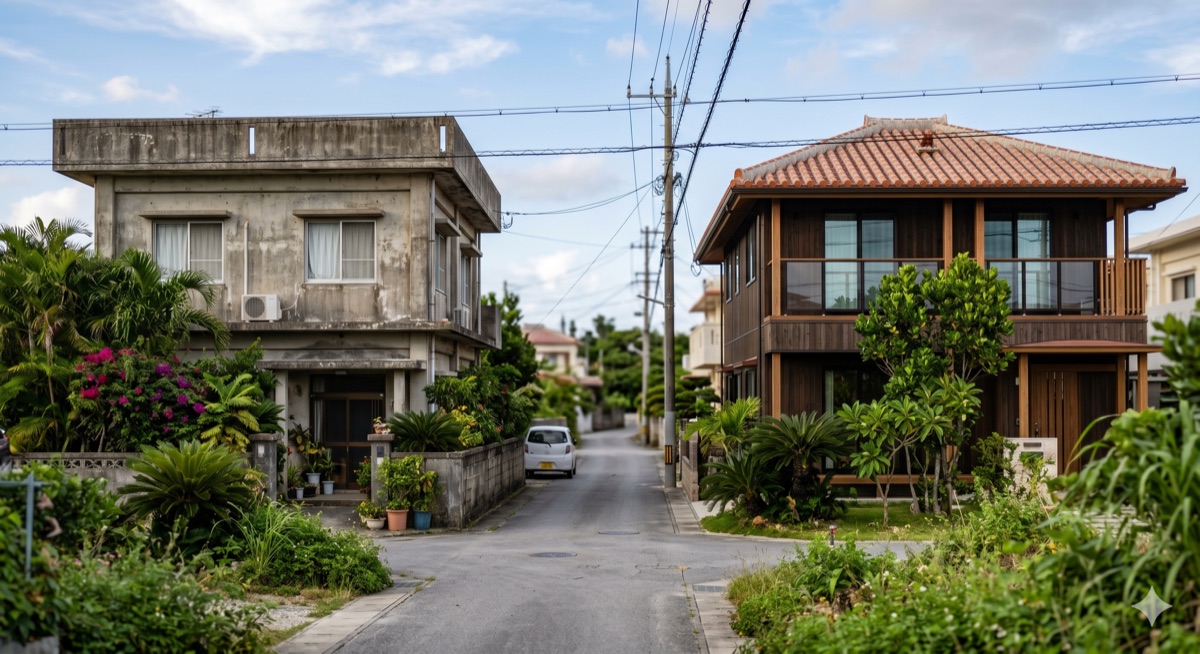
The short answer
Okinawa is the most concrete-built prefecture in Japan. After WWII, reinforced concrete (RC, 鉄筋コンクリート) and concrete block became the default because wood had failed catastrophically against typhoons and termites — and for decades roughly 80–90% of homes here were concrete, the inverse of mainland Japan where wood always dominated.
That era is ending. By 2023, of the detached houses built in Okinawa, wood made up about 42% and RC about 46% — a near-even split that would have been unthinkable in 2005. New wood construction has roughly quadrupled in ten years. The drivers: national homebuilders entered the market, concrete and labor costs climbed, modern termite treatment got far better, and engineered wood now meets the same typhoon and seismic code minimums concrete does — at a meaningfully lower price. (Meeting the same code minimum isn't the same as matching concrete's strength in an extreme storm — more on that below.)
If you're buying: the structure type (構造) is one of the most important lines in any Okinawa listing. Concrete is the stronger building — it has the best survival record in the most violent typhoons and holds its resale value — but it costs more and carries a hidden salt-air maintenance bill. Wood is cheaper and more comfortable in the heat and, built to modern code, handles ordinary typhoons well — but it needs disciplined termite management and doesn't match concrete's margin in a direct Category-4-to-5 hit. They aren't equals; the right pick depends on which tradeoffs matter most to you.
How concrete took over
Pre-war Okinawa built in wood — the red-tiled, low-slung Ryukyu house with deep eaves and a fukugi windbreak hedge, designed over centuries for typhoons and heat. The Battle of Okinawa erased most of it. Roughly 100,000 homes were destroyed, and the immediate post-war response was emergency wooden housing — around 80,000 hastily built units, plus standardized 2×4 timber houses supplied by the US military.
Those houses were built from whatever was available: poor-grade lumber, often salvaged and reused from demolished structures. They rotted, they were eaten by termites, and they came apart in typhoons. Within a generation, Okinawans drew a hard conclusion that still echoes today: wood doesn't last here. When concrete block and reinforced concrete became available, the whole prefecture pivoted, and the government actively promoted concrete construction. By the 1970s, concrete was simply what a "real" house was made of in Okinawa.
The logic was sound. Concrete doesn't burn, termites can't eat it, and a properly built RC box barely notices a typhoon that would peel the roof off a poorly built wooden one. For decades that tradeoff was correct, and it's why the Okinawa streetscape looks the way it does — flat roofs (often with a rooftop water tank and space to add a second floor later), exposed concrete, and almost no pitched-roof timber houses of the kind that blanket mainland suburbs.
What's actually hit Okinawa. Okinawa is Japan's most typhoon-exposed prefecture — about 7 typhoons approach per year. Record maximum gusts:
- Miyakojima, 1966 (2nd Miyakojima Typhoon / Cora): 85.3 m/s — 191 mph, still Japan's highest recorded gust; over half the island's homes were destroyed.
- Miyakojima, 1968: 79.8 m/s (178 mph).
- Miyakojima (Maemi), 2003: 74.1 m/s (166 mph).
- Naha, main island (Trami), 2018: 50.8 m/s (114 mph).
The most extreme storms have struck the outer islands (Miyako, Yaeyama) hardest; the main island around Naha typically records lower peaks. Note that Japan measures sustained wind as a 10-minute average — lower than the 1-minute average the US Saffir–Simpson hurricane scale uses — so these rate a notch higher on the American scale than a direct number swap suggests.
The concrete problem nobody puts in the brochure
Concrete's weakness in Okinawa isn't the concrete — it's the steel inside it. Reinforced concrete depends on steel rebar (鉄筋) for its tensile strength, and that rebar is protected only by the alkaline concrete around it. In Okinawa's salt-laden air, chloride ions migrate through the concrete, break down the rebar's protective layer, and the steel begins to rust.
Rusting steel expands to several times its original volume. That expansion cracks the concrete from the inside and eventually blows chunks of it off the surface — a failure mode Okinawans know by name: concrete spalling, or 爆裂 (bakuretsu, "bursting"). You'll see it on older buildings as rust-stained cracks and patches where the surface has fallen away, exposing corroded rebar beneath.
This is not a rare or marginal problem here. A University of the Ryukyus study found that steel in Okinawa corrodes roughly ten times faster than in mainland regions, driven by salt carried inland on the constant sea wind. Two things make the historic building stock especially vulnerable:
- Thin concrete cover (かぶり厚). Building code requires a minimum of about 3cm of concrete between the rebar and the surface. Cut that corner — as many older builds did — and salt reaches the steel far sooner.
- Sea sand in the mix. During the building boom of the Shōwa 40s (1965–1974), demand outstripped supply and builders used unwashed sea sand (海砂) instead of river sand. That baked salt directly into the concrete from day one. Buildings from this era crack and spall noticeably early — Naha's beloved Civic Hall is a frequently cited casualty.
RC is not maintenance-free. This is the myth that catches buyers. A concrete house in Okinawa needs its exterior waterproof coating renewed roughly every 10–15 years to keep salt and water out of the structure — budget ¥800,000–¥1,500,000+ each cycle for a typical house. Skip it and you're on the road to spalling, which is far more expensive to repair. When you view an older RC house, look for rust-stained cracks, surface patches, and ask when the exterior was last recoated.
Why wood is coming back
Given all that, why is anyone building wood in Okinawa again? Several things changed at once:
The big homebuilders arrived
National house manufacturers (大手ハウスメーカー) — the companies that mass-produce engineered wooden homes across mainland Japan — moved into the Okinawa market with marketing budgets and standardized, factory-cut timber packages. They brought mainland wood-building norms and the volume to make them affordable here.
Concrete got expensive — and stayed expensive
Material and labor costs rose sharply across the 2020s, and RC felt it hardest. Concrete construction is labor-intensive and slow: it needs formwork, curing time, and specialized crews. As the price gap with wood widened, the concrete premium became harder to justify for an ordinary family home.
Wood engineering caught up
Modern wooden construction is not the salvaged-lumber shack of 1950. Today's engineered timber homes use treated wood, metal hold-down hardware, and structural designs that meet Japan's earthquake codes and Okinawa's 46 m/s typhoon wind standard (≈103 mph / 166 km/h). And termite treatment has improved enormously — chemical barriers and bait systems that genuinely work, applied as standard on new builds.
Wood is more comfortable in the heat
Concrete has high thermal mass (蓄熱性): it soaks up the day's heat and radiates it back at night, which is exactly the wrong behavior in a subtropical climate. Many residents of older RC houses know the feeling of a bedroom that stays hot long after sunset. Wood doesn't store heat the same way and is generally easier to keep comfortable, which has become a real selling point as energy costs rise.
The numbers tell the story. New wood construction quadrupled over the decade to 2023, when wood (42%) and RC (46%) nearly split the detached-house market. (Counting all building types, wood was about 32% of starts in 2024 — down year-on-year as overall construction cooled with material costs, but structurally far above where it sat a decade ago.)
Wood vs. concrete: the honest comparison
There's no universal winner — the right answer depends on your budget, how long you'll hold the property, and how much maintenance you're willing to do. Here's the real tradeoff:
| Factor | Wood (木造) | Reinforced concrete (RC) |
|---|---|---|
| Build cost (per tsubo) | ~¥80–90万 | ~¥107–130万 |
| Build time | ~4–6 months | ~6–10 months (curing) |
| Typhoon resistance | Strong to code for ordinary typhoons; walls typically start failing ~130–150 mph | Strongest — best survival record in Cat 4–5 storms |
| Salt-air durability | Good — no rebar to corrode; needs ventilation | Spalling risk; recoat every 10–15 yrs |
| Termite risk | Higher exposure, but treatable | Lower — but not immune (interior wood) |
| Heat & comfort | Cooler at night; breathes better | Stores heat (蓄熱); hot evenings |
| Ongoing maintenance | Repaint + termite re-treatment ~5 yrs | Exterior waterproof recoat ~10–15 yrs |
| Typical lifespan / resale | Long with upkeep; improving resale | Long; strong resale, "premium" perception |
Per-tsubo figures are Okinawa new-build averages for early 2026 (1 tsubo ≈ 3.3㎡). Okinawa runs above the national average for both structure types because of shipped-in materials and typhoon-spec requirements.
A note on earthquakes: on the mainland, seismic performance is a major part of the wood-vs-concrete debate. Okinawa sits in a relatively low-seismicity zone compared to Honshu, so the conversation here is dominated by typhoons, salt, and termites rather than earthquakes — though all new construction still meets national seismic code.
The termite question
Termites (シロアリ) are the single biggest reason wood got its bad reputation in Okinawa, and they deserve a clear-eyed look. The dominant species here is the Formosan subterranean termite (イエシロアリ, Coptotermes formosanus), which accounts for essentially all serious structural damage in the prefecture. It is far more aggressive than the termites of mainland Japan: colonies run from the hundreds of thousands into the millions, and the colony can carry its own water to dampen and attack even dry timber.
Two other species matter: ヤマトシロアリ (across most of Japan, prefers damp wood) and ダイコクシロアリ (a drywood termite found only in Okinawa and the Amami islands, which needs specialist treatment). Their presence is why termite management here is a continuous practice, not a one-time box-tick.
How modern wood houses defend against them
- Slab foundation (ベタ基礎). Covering the entire ground footprint in concrete removes the easy soil-to-wood path termites prefer.
- A dry, ventilated crawl space. Formosan termites need moisture; keeping the underfloor dry is half the battle.
- Chemical barrier + bait systems. Soil and timber treatment (防蟻) plus perimeter bait stations. The chemical barrier typically needs re-treatment every ~5 years — budget ¥100,000–¥250,000 per cycle.
- Regular inspection. Early detection is everything; a colony caught early is a minor cost, one caught late is structural.
Concrete houses get termites too. This surprises people. An RC structure still contains wood — interior framing, furring strips, door and window frames, flooring — and Formosan termites will travel up through or around the concrete to reach it. Buying concrete lowers your termite exposure; it does not eliminate it. Any house in Okinawa, of any structure type, benefits from a termite-prevention plan.
What each costs to build
If you're building rather than buying existing, the structure decision is the biggest single line in the budget. Okinawa runs above the national average for both — the prefecture imports most building materials by sea, and everything must meet typhoon spec.
| Metric | Wood (木造) | RC |
|---|---|---|
| Okinawa avg, per tsubo | ~¥86.8万 | ~¥107万 |
| National avg, per tsubo | ~¥81.1万 | ~¥101万 |
| Premium RC builders quote | — | up to ~¥130万 |
| Okinawa custom-home average (all structures) | ~¥3,925万 | |
Per-tsubo figures from Okinawa builder data (early 2026). The Okinawa custom-home average (~¥3,925万) runs about ¥500万 above the national average (~¥3,405万), driven by shipped-in materials and typhoon reinforcement.
On a typical 35-tsubo (~116㎡) house, the per-tsubo gap works out to roughly ¥7–15 million more for RC than for wood before you account for the longer RC build schedule. That gap — invisible when concrete was the unquestioned default — is the single biggest force pushing new builds toward wood.
What this means if you're buying
Most buyers aren't building from scratch — they're choosing among existing houses, which means inheriting whatever structure and maintenance history a property already has. A few practical rules:
- Read the structure label. Listings state the structure: 木造 (wood), 鉄筋コンクリート造 / RC造 (reinforced concrete), or 鉄骨造 (steel frame). Our guide to reading Japanese property listings decodes every field you'll see.
- For older RC, hunt for spalling. Rust-stained cracks, bulging or patched surfaces, and exposed rebar are red flags. Ask when the exterior waterproof coating was last renewed — if the answer is "never" or "20 years ago," budget for it immediately. Be especially cautious with Shōwa-40s (1965–74) builds because of the sea-sand era.
- Don't dismiss modern wood on the old stigma. A post-2015 engineered wooden house built by a reputable maker is a genuinely sound choice in Okinawa — typhoon- and termite-engineered, cheaper, and more comfortable — even though concrete still outlasts it in an extreme direct hit. The "wood doesn't last here" rule was written about 1950s salvage lumber, not today's product; the honest update is "modern wood is good," not "modern wood equals concrete."
- Whatever you buy, budget maintenance. RC means a recoat cycle; wood means termite re-treatment and repainting. There is no zero-maintenance house in this climate — only houses whose owners have kept up and houses whose owners haven't.
- Match the structure to your horizon. Holding for the long term and want lowest hassle through storms? RC's resilience and resale strength favor it. Optimizing upfront cost and day-to-day comfort? Modern wood is increasingly the value pick.
Related reading: the same salt air and 46 m/s (≈103 mph) wind standard shape everything outdoors too — see our guide to carports and why Okinawa houses skip the garage. For the full purchase process, taxes, and local bank rates, see Can Foreigners Buy Property in Okinawa?
Frequently asked questions
Sources & further reading
- 日本経済新聞 — 沖縄、新築木造比率 10年で4倍(台風・潮風対策でRCに変調)
- 沖縄県公式 — 住宅建設の動向(新設住宅着工・構造別統計)
- 琉球新報 — 沖縄の建造物は県外の10倍さびやすい(琉大・下里教授の比較研究)
- スケルトン設計 — 沖縄県はなぜコンクリート住宅が多いのか?
- 都市建築設計 — 沖縄の家づくり 塩害対策と劣化を防ぐ設計のコツ(鉄筋爆裂・かぶり厚)
- 沖縄タイムス住まい — RC造を塩害から守る
- イシンホーム那覇 — 沖縄の木造住宅と鉄筋コンクリート住宅を比較
- イシンホーム那覇 — 沖縄の注文住宅価格と坪単価(木造・鉄骨・RC)2025
- イシンホーム那覇 — 沖縄の木造住宅でシロアリを防ぐ工夫と種類
- 沖縄タイムス住まい — シロアリから家を守る
- ぬちぐすいビルド — 沖縄の住まいにおける木造・鉄骨住宅の現状(戦後史)
- 琉球大学学術リポジトリ — Perspectives on the Resilience of Okinawan Housing against Typhoons
- Fast Company — On this Japanese island, nearly every building is made of concrete