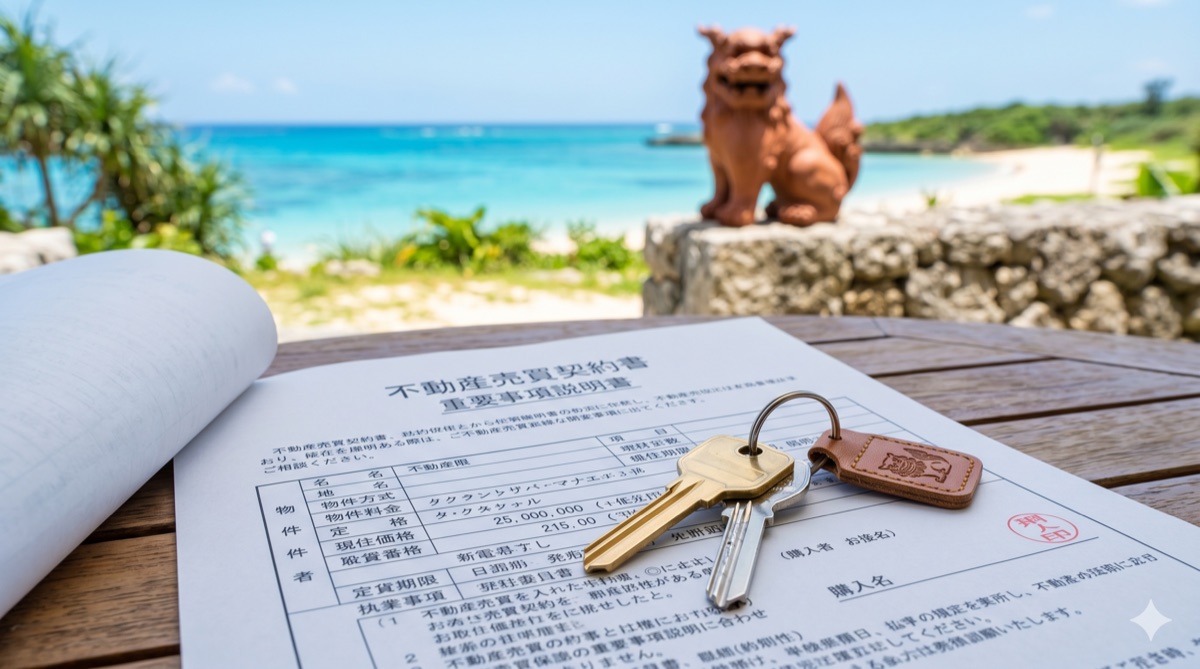
The short answer
Japan places no nationality-based restrictions on property ownership. You can buy a house, apartment, or land in Okinawa whether you are a tourist, a long-term resident, or someone who has never set foot in Japan. No visa, no residency status, no government approval required.
You receive the same full freehold ownership rights as a Japanese national. You can sell, rent, renovate, or pass the property on to your heirs. There is no expiry date on ownership and no periodic renewal requirement.
One thing that changed in April 2026: All buyers — Japanese and foreign alike — must now declare their nationality when registering a property transfer. This is a transparency measure, not a purchase restriction. It does not affect your ability to buy.
What ownership actually means
Japanese property law grants foreign buyers freehold title — the strongest form of ownership. Once the transfer is registered, the property is legally yours with no time limit.
A few things worth knowing:
- Land and building are registered separately. In Japan, land and the structure on it are treated as distinct assets, each with its own registration entry. Your purchase agreement will cover both.
- Agricultural land is restricted. Farmland (農地, nōchi) requires approval from the local agricultural committee to transfer. Standard residential and commercial properties have no such restriction.
- Condominiums come with a land share. When you buy an apartment in a managed building, you also acquire a proportional share of the land underneath — it is bundled into the sale price.
What changed in 2026
Two new requirements took effect in April 2026, both aimed at transparency rather than restriction:
Nationality declaration at registration
When your judicial scrivener (see below) files the ownership transfer at the Legal Affairs Bureau, they must now include your nationality. This information is stored in the government's registry database but does not appear on publicly accessible title certificates. The goal is to let the government track foreign ownership patterns nationwide — not to screen or block buyers.
FEFTA reporting for non-residents
Under the Foreign Exchange and Foreign Trade Act (FEFTA), non-resident buyers have always been required to report certain property acquisitions to the Bank of Japan. From April 2026, this obligation was expanded to cover all residential property purchases by non-residents, closing a previous exemption for personal-use homes. You have 20 days from the date of acquisition to file the report. Your agent or scrivener can help with this.
Watch this space: Japan's government commissioned a study in late 2025 comparing foreign ownership rules in other countries, with findings expected by March 2026. Further restrictions are possible but not yet enacted. As of May 2026, there are no additional taxes or approval requirements for foreign buyers.
The buying process, step by step
A typical purchase in Okinawa takes 4–8 weeks from accepted offer to handing over keys, though cash deals can close faster. Here is how it works:
-
Find an agent experienced with foreign buyers
Not all Okinawa agents work with foreigners or provide English-language support. Use a bilingual agent or one with a dedicated foreign buyer service. They handle the paperwork, translate key documents, and coordinate with the scrivener.
-
Submit a purchase offer (Letter of Intent)
A non-binding written offer stating your proposed price, closing date, and conditions. The seller can accept, reject, or counter. This stage typically takes a few days to a week.
-
Receive the Explanation of Important Matters
This is a legally mandated disclosure document the agent must present before you sign anything binding. It covers the property's legal status, zoning, utility connections, any restrictions or encumbrances, and management rules (for condominiums). English summaries are standard for foreign buyers, though the official document will be in Japanese.
-
Sign the Sale and Purchase Agreement and pay the deposit
The binding contract. You pay a deposit of 5–10% of the purchase price at signing. After this point, cancellation typically means forfeiting the deposit (or paying a penalty if the seller cancels).
-
Arrange your funds
Non-resident buyers nearly always pay cash — Japanese banks rarely extend mortgage financing to people without Japanese residency. If you are wiring funds internationally, budget extra time for compliance checks and source-of-funds documentation. Wise and other international transfer services work well for this.
-
Settlement day
You pay the remaining balance. At the same time, a judicial scrivener (司法書士, shiho-shoshi) — a nationally licensed legal professional — files the ownership transfer at the Legal Affairs Bureau. Ownership passes to you on this day. Your agent coordinates everything; you typically sign documents and receive keys.
-
Post-purchase obligations
If you are not a Japanese resident, you must appoint a Tax Payment Agent in Japan to receive and pay your annual tax notices. You also need to file the FEFTA report with the Bank of Japan within 20 days. Your agent can usually refer you to a scrivener or accountant for both.
What it costs: a realistic breakdown
On top of the purchase price, budget roughly 7–10% in closing costs. Below is a breakdown for a typical residential purchase. Note that "assessed value" — used for tax calculations — is set by the government and is usually 60–70% of what you actually pay.
| Cost | Rate / Amount | Notes |
|---|---|---|
| Agent commission | 3% + ¥60,000 + 10% tax | Capped by law. On a ¥30M purchase: ~¥1,056,000 |
| Registration & license tax (land) | 1.5% of assessed value | Reduced from 2%; applies through March 2027 |
| Registration & license tax (building) | 0.1–0.3% of assessed value | Reduced rate for residential; applies through March 2027 |
| Real estate acquisition tax | 3% of assessed value | Paid 3–6 months after registration; reduced from 4% |
| Judicial scrivener fee | ¥80,000–¥150,000 | Handles title transfer registration |
| Stamp duty | ¥10,000–¥30,000 | On the sale contract; ¥10K for ¥10–50M contracts, ¥30K for ¥50–100M |
| Translation / admin | ¥50,000–¥150,000 | Varies by agent; sometimes included in commission |
| Typical total closing costs | ~7–10% of purchase price | |
Rates above are current as of May 2026. Reduced rates on registration and acquisition tax are in effect through March 31, 2027.
Ongoing costs after you buy
Fixed Asset Tax (固定資産税)
Paid annually, calculated at 1.4% of the government's assessed value — not the price you paid. Assessed value is typically 60–70% of market value. You can pay in a lump sum or four installments. For a ¥30M house with an assessed value of ¥20M, the annual fixed asset tax would be around ¥280,000 (~$1,870 at ¥150/$).
City Planning Tax (都市計画税)
An additional 0.3% of assessed value applies in designated urban planning zones, which covers much of central and southern Okinawa. It is collected alongside the fixed asset tax.
Tax Payment Agent (非居住者の場合)
If you do not have a registered address in Japan, you are legally required to appoint a Tax Payment Agent — a person or service in Japan who receives your tax notices and handles payment on your behalf. This is not a big burden: many scrivener offices and accountants offer this as an annual service for around ¥30,000–¥60,000 per year.
Getting a mortgage
This is where the path forks significantly depending on your residency status.
Non-residents (living outside Japan)
Japanese banks almost universally require a Japanese address to extend a home loan. If you are buying from abroad with no intention to live in Japan, plan to pay cash. Some buyers finance through their home country using equity in existing property or an overseas investment loan.
Residents with permanent residency (PR)
Access to loans is essentially the same as for Japanese nationals. The three local Okinawa banks all lend to PR holders:
- 琉球銀行 (Bank of the Ryukyus) — the largest local bank. Variable rates from ~0.5%, Flat 35 fixed from 1.99% as of early 2026. The variable basis rate was revised upward on April 1, 2026.
- 沖縄銀行 (Bank of Okinawa) — second-largest. Offers a "rate-selection" mortgage with variable or 3/5/10-year fixed-rate options.
- 沖縄海邦銀行 (Okinawa Kaiho Bank) — third local bank. Distinctive feature: cancer-coverage life insurance attachment (がん団信) for just +0.1% on rate, considered competitive vs mainland equivalents.
National banks (Mizuho, MUFG, SMBC) also lend at comparable rates and can be worth comparing — particularly Flat 35, where the floor is national. Aggregator sites like Diamond Fudosan's Okinawa mortgage simulator compare 130+ banks at once.
Residents with long-term visas (no PR)
A handful of banks specifically serve non-PR foreign residents: Suruga Bank (Special Mortgage for Foreigners), SMBC Prestia, Tokyo Star Bank, and Aeon Bank. Expect stricter conditions: 20–30% down payment, shorter repayment terms, and 1–3 years of stable employment in Japan typically required. Flat 35 is technically available to long-term visa holders, though individual partner banks apply their own criteria on top.
Okinawa tip: Okinawa has a higher concentration of US military-affiliated buyers than anywhere else in Japan. Some local agents and lenders have developed specific processes for SOFA-status buyers purchasing off-base. If this applies to you, ask your agent explicitly.
What to expect on price
Okinawa used to be one of Japan's more affordable prefectures for residential property. That's becoming less true. Prefectural land prices rose +6.4% in 2026, ranking Okinawa 8th nationally for residential land prices. Naha land averaged ¥330,200/㎡ (+6.0% YoY) and Chatan averaged ¥205,600/㎡ (+9.2% YoY) in 2026. The "cheap Okinawa property" narrative reflects a market that no longer fully exists in the central corridor.
Actual transaction prices (Naha, 2025)
Naha's average sale price for a residential property in 2025 was ¥39.57M (down 4.2% YoY — the small dip after years of sharp gains). By layout:
- 1LDK / 2K / 2DK: ¥33.6M average
- 2LDK / 3K / 3DK: ¥76.2M average (skewed by larger central condos)
- 3LDK / 4K+: ¥66.3M average
Indicative price bands by property type and area
- Older house on land (築古), rural north / outer islands: ¥5M–¥15M (~$33K–$100K)
- Older house on land, central/suburban: ¥15M–¥35M (~$100K–$235K)
- Modern house (新築・築浅), suburban: ¥35M–¥60M (~$235K–$400K)
- Condominium, Naha/Chatan central: ¥25M–¥60M (~$165K–$400K)
- Naha or Chatan beachfront / resort condo: ¥60M+ (~$400K+)
Northern Okinawa (Nago, Motobu, Kunigami) and the outer islands (Miyakojima, Ishigaki) offer lower entry points with different tradeoffs in infrastructure and commute. Akiya (vacant house) listings under ¥15M exist via municipal "akiya bank" programs — see 沖縄県公式移住応援サイト for the official list by municipality.
Okinawa-only: military land (軍用地) as an investment
Roughly 15% of Okinawa's main island is leased to the US military or JSDF — and nearly all of it is privately owned land that the Japanese government rents from individual landlords. This creates an investment vehicle that exists almost nowhere else in the country: gunyōchi (軍用地), military-leased land you can buy as a passive income asset.
How it works:
- You buy the title to a parcel already under government lease. The lease continues — you become the new lessor.
- The Defense Bureau pays annual rent directly to you. Lease rates are renegotiated annually between the government and the prefectural landlords' association (沖縄県軍用地主連合会), and have risen almost every year for decades.
- No tenants, no maintenance, no vacancy risk. The land just sits there.
- Price is calculated as annual rent × multiplier (倍率), not by area. Multipliers run higher in zones unlikely to be returned to civilian use (Kadena, Camp Foster) and lower where return is on the table.
- Typical yield: ~1–2%. Lower than ordinary rental property, but with near-zero running costs and very stable cash flow.
The catch is return risk (返還リスク). When a base or training area is returned to civilian use — as has happened repeatedly since the 1972 reversion — your lease income ends. The land becomes ordinary residential or commercial real estate, which is sometimes worth more and sometimes worth less depending on location. Specialist agencies like Kainan Corporation (開南コーポレーション) and Oroku Shōkai handle most gunyōchi transactions.
Foreign-buyer note: Foreigners can buy gunyōchi on the same legal basis as any other land in Japan. The defense rent is paid by Japanese government check — no foreign-tax-treaty complications. The investment-grade gunyōchi market is small and largely Japanese; bilingual brokers exist but you may need a Japanese-speaking advisor for diligence on multipliers and return-risk assessment.
Frequently asked questions
Sources & further reading
- 琉球銀行 — 住宅関連ローン (Bank of the Ryukyus mortgages)
- 沖縄銀行 — 金利選択型住宅ローン (Bank of Okinawa rate-selection mortgage)
- 沖縄海邦銀行 — 住宅ローン (Okinawa Kaiho Bank mortgages)
- Diamond Fudosan — 沖縄県のおすすめ住宅ローンランキング (Okinawa 130-bank mortgage comparison, March 2026)
- Diamond Fudosan — 沖縄県の公示地価 2026 (Okinawa 2026 land prices +6.4%)
- アットホーム — 沖縄県の一戸建て・分譲住宅の価格相場
- うちなーらいふ — 沖縄県の売買新築・中古一戸建て情報
- 沖縄県公式移住応援サイト — おきなわ島ぐらし (akiya bank, relocation support)
- 沖縄県公式 — 住宅宿泊事業 (Minpaku Act enforcement)
- 那覇市公式 — 民泊(住宅宿泊事業法)
- 開南コーポレーション — 軍用地とは・投資ガイド (gunyōchi specialist)
- 中部興産 — 軍用地投資の利回りとメリット・デメリット
- VILLA Okinawa Real Estate — Purchase Process for Foreign Buyers (Jan 2026)
- The Japan Times — Japan to require nationality declaration for property registration (Dec 2025)