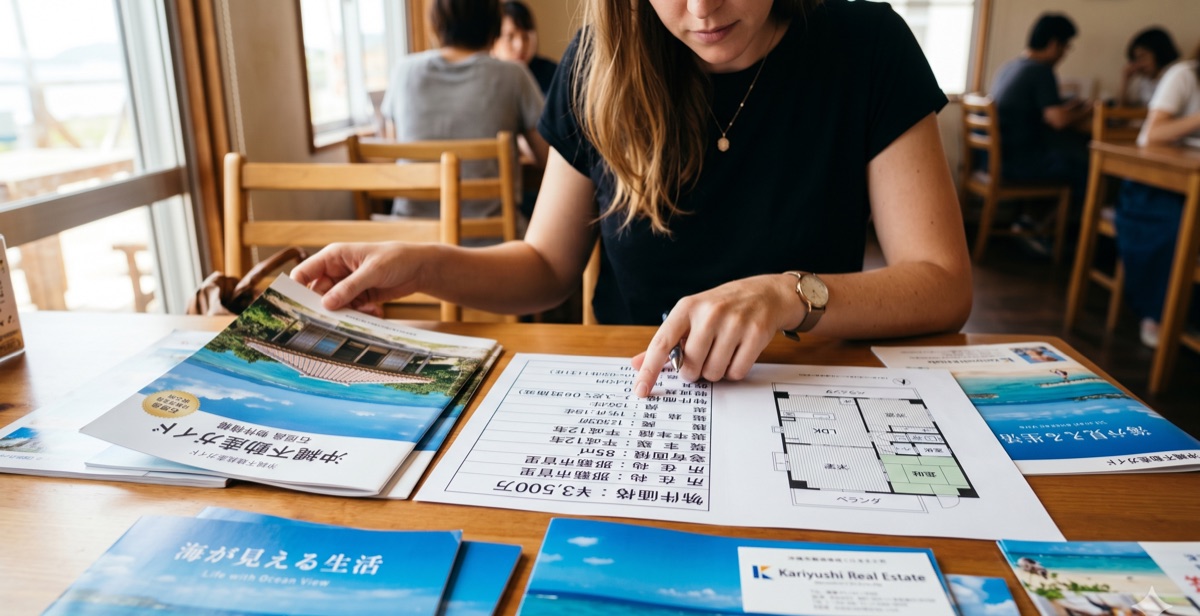
Reading a Real Listing Card
Before diving into individual terms, here's what a typical Okinawa property listing looks like — and what every field actually means. This is modeled on the format used by e-uchina.net, the main Okinawa real estate portal, and the listings you'll find on this site.
The 万円 Price System
Japan counts large numbers in units of 10,000 (万, man). Property prices are always listed in 万円 — you multiply the number you see by 10,000 to get yen, then divide by your exchange rate for dollars.
| As listed | In yen | Approx. USD (¥150/$) | What you're looking at |
|---|---|---|---|
| 500万円 | ¥5,000,000 | ~$33,000 | Cheap rural land or a rundown akiya |
| 1,500万円 | ¥15,000,000 | ~$100,000 | Older apartment or small house inland |
| 2,500万円 | ¥25,000,000 | ~$167,000 | Solid 3LDK mansion in mid-Okinawa |
| 4,000万円 | ¥40,000,000 | ~$267,000 | Newer condo in Chatan or coastal Naha |
| 8,000万円 | ¥80,000,000 | ~$533,000 | High-end oceanfront or new-build luxury |
Quick mental math: Drop four zeros and convert. 3,200万 → ¥32,000,000 → divide by 150 → roughly $213,000. At ¥145/$, same property is ~$221,000. The FX rate matters — a 10-yen swing on a ¥30M property is $20,000.
Layout Codes: K, DK, LDK
Every Japanese listing shows a layout code that tells you how many rooms the property has and what kind of shared space connects them. The number prefix is the bedroom count; the letters describe the main living area.
The "S" (service room) catch: A 2SLDK listing is not a 3-bedroom. The S room has no legally required window — it's often used as storage, a study, or a nursery, but don't count on sunlight. In Okinawa's humid climate, windowless rooms grow mold fast without a dehumidifier.
Property Types: Mansion, Apato, Ikkodate
Three words appear on every Okinawa listing. They mean something very specific in Japanese real estate — not what they suggest in English.
Building Structure Codes
The 構造 (kōzō) field tells you what the building is made of. This matters enormously for earthquake safety, soundproofing, humidity resistance — and in Okinawa specifically, typhoon resilience.
| Code | Japanese | Full name | What it means | Okinawa rating |
|---|---|---|---|---|
| RC | 鉄筋コンクリート | Reinforced Concrete | Steel rebar embedded in concrete. The standard for Okinawa mansions. Strong against typhoons and earthquakes; good sound insulation; retains heat in summer. | Excellent |
| SRC | 鉄骨鉄筋コンクリート | Steel-Reinforced Concrete | Steel frame + rebar + concrete. Used in larger, taller buildings. Superior structural strength. Rare in Okinawa residential but exists in newer high-rise condos. | Superior |
| S | 鉄骨造 | Steel Frame | Steel frame without concrete cladding. Common in light-steel apato. Moderate typhoon resistance, thinner walls, noisier. | Moderate |
| 木造 | 木造 | Wood Frame | Traditional wooden construction. Cheapest, noisiest, worst against typhoons. Very rare in Okinawa (where concrete has been dominant since WWII). Almost always apato. | Avoid |
| 軽量鉄骨 | 軽量鉄骨造 | Light Steel Frame | Thin steel sheet construction. Cheaper than RC, better than wood. The typical material for 2-story apato. Acoustics and insulation are noticeably worse than RC. | Fair |
Okinawa is overwhelmingly concrete: The US military rebuilt Okinawa in concrete after WWII, and typhoon culture reinforced that preference. You'll rarely see 木造 (wood) listings on Okinawa main island. If you do, look carefully at the typhoon shutter situation.
Measurements: m², Tsubo, and Jo
Japanese listings use three area units — sometimes on the same listing. All three can appear in a single property card, describing different things.
= 3.306 m²
= 35.58 sq ft
= 2 tatami mats
= 1.653 m²
= 17.79 sq ft
= ½ tsubo
= 0.3025 tsubo
= 0.605 tatami
= 10.76 sq ft
Where each unit appears:
- m² (平方メートル) — used for apartment floor area (専有面積) and building area (建物面積). This is the metric you'll see most often on modern listings.
- 坪 (tsubo) — used to price land and occasionally buildings. Land listings often show price-per-tsubo (坪単価). Okinawa prices typically run ¥30,000–¥200,000 per tsubo depending on location and zoning.
- 畳 (jo) — used to describe individual room sizes within a listing. A "6畳 bedroom" is about 9.9 m² or 107 sq ft — small by Western standards but normal in Japan.
専有面積 vs 建物面積: Apartments list 専有面積 (private floor area — what you actually own). Houses list 建物面積 (total building area). For houses, also check 土地面積 (land area) — you need both to understand what you're getting. The land area often matters more for pricing than the building itself.
Building Age and the 1981 Seismic Line
The 築年数 (chikunensū) field shows when the building was constructed. In Japan, the construction year is arguably the most important number in a listing after the price — because it determines which earthquake safety standard the building was built to.
Quick rule of thumb for Okinawa: If the listing shows 築 1981年以前, ask for a seismic inspection report before getting serious. If it shows 築 1981年以降, you're in new-standard territory. For RC mansions built post-1990, seismic concerns are usually secondary to typhoon shutters and humidity.
Key Listing Fields Decoded
Negotiation Status — What Those Labels Mean
Okinawa listings often carry a status badge that tells you where the property is in its sales lifecycle. These are critical — a property marked 売約済 is gone, and you're wasting time requesting details.
Hidden Costs in the Listing Price
The listed price (物件価格) is not your total cost. Japanese real estate transactions add several mandatory costs on top of the sale price. Budget approximately 7–10% of the purchase price in transaction costs.
| Cost | Japanese | Typical amount | Notes |
|---|---|---|---|
| Agent commission | 仲介手数料 | 3% + ¥60,000 + tax | Legally capped. On a ¥25M purchase: ~¥870,000. |
| Registration tax | 登録免許税 | 0.4–2% of assessed value | Assessed value (固定資産税評価額) is usually 60–70% of market price. |
| Stamp duty | 印紙税 | ¥10,000–¥60,000 | Based on contract value. Reduced rates apply through March 2027. |
| Acquisition tax | 不動産取得税 | 3–4% of assessed value | One-time tax; bill arrives 3–6 months after purchase. Reduction available for primary residences. |
| Judicial scrivener fee | 司法書士費用 | ¥80,000–¥200,000 | Handles ownership registration. Required for all transfers. |
| Annual property tax | 固定資産税 | 1.4% of assessed value/yr | Ongoing — billed quarterly. For a ¥25M property, expect ¥100,000–¥200,000/year. |
Okinawa-Specific Listing Notes
A few things you'll only see — or see constantly — in Okinawa listings:
- 台風シャッター (taifū shattā) / 雨戸 (amado): Typhoon storm shutters on all windows. Listings that mention these prominently are flagging a key feature — in Okinawa, proper shutters are not optional. Check that every window has coverage before buying.
- 駐車場 (chūshajō): Parking. Many Okinawa listings include dedicated parking (1台 = 1 space, 2台 = 2 spaces). Island life is car-dependent — confirm parking before falling in love with a property.
- 沖縄県 / 島内 (Okinawa-ken / tō-nai): Listings will specify the city or village. Remember that "Okinawa City" (沖縄市) and "Okinawa Prefecture" (沖縄県) are different things — Okinawa City (Koza) is a specific municipality in central Okinawa.
- RC dominance: Unlike mainland Japan where wood-frame homes are common, virtually all Okinawa residential buildings are RC. This is a feature, not a quirk — it means typhoon and earthquake resistance even in older stock.
- 米軍基地 (bei-gun kichi): US military base proximity. Some listings will flag this (positively or negatively). Properties near bases in Chatan, Ginowan, Yomitan, and Okinawa City see specific demand from military families, which both supports prices and limits some neighbors' preferences.
- 海が見える (umi ga mieru): "Ocean view" — one of the most common value-add phrases in Okinawa listings. Confirm which direction and what floor; an ocean view on the 2nd floor of an Onna Village property can vanish when the neighbor builds a wall.
Where to Find Okinawa Listings
Most Okinawa listings originate from a handful of portals. The same property often appears across multiple sites — prices should match; if they don't, the newer listing is more likely to be current.
| Site | Coverage | English? | Best for |
|---|---|---|---|
| liveOki (this site) | e-uchina.net data, updated nightly | ✓ Yes | Searchable English interface with price-drop tracking and neighborhood filters |
| e-uchina.net | Largest Okinawa-only portal | ✗ Japanese only | Primary source — most complete inventory, often listed first here |
| SUUMO (スーモ) | National, includes Okinawa | ✗ Japanese only | Large-agency listings; some overlap with e-uchina; good for new construction |
| Homes.co.jp | National, includes Okinawa | ✗ Japanese only | Broad inventory; useful for rental comparison |
| VILLA Okinawa | Okinawa-focused | ✓ Partial English | Foreigner-facing agency; specializes in expat buyers |
| Bookoo Okinawa | Military community classifieds | ✓ Yes | SOFA / military housing; off-base rentals from military families |
Frequently Asked Questions
Sources
- Delta Estate Asia — Japan Real Estate Terminology
- Tokyo Portfolio — How to Read Japanese Real Estate Listings
- Nippon Tradings — Japanese Real Estate Measurement Units
- Plaza Homes — Earthquake Resistance of Buildings in Japan
- Real Estate Japan — Glossary of Selling & Purchasing Terms
- Mpathian — Japan Property Listing Information Explained
- GaijinPot — Japanese Apartment Layout Terms
- Hokushin Fudosan — Earthquake Resistance Standards for Investors