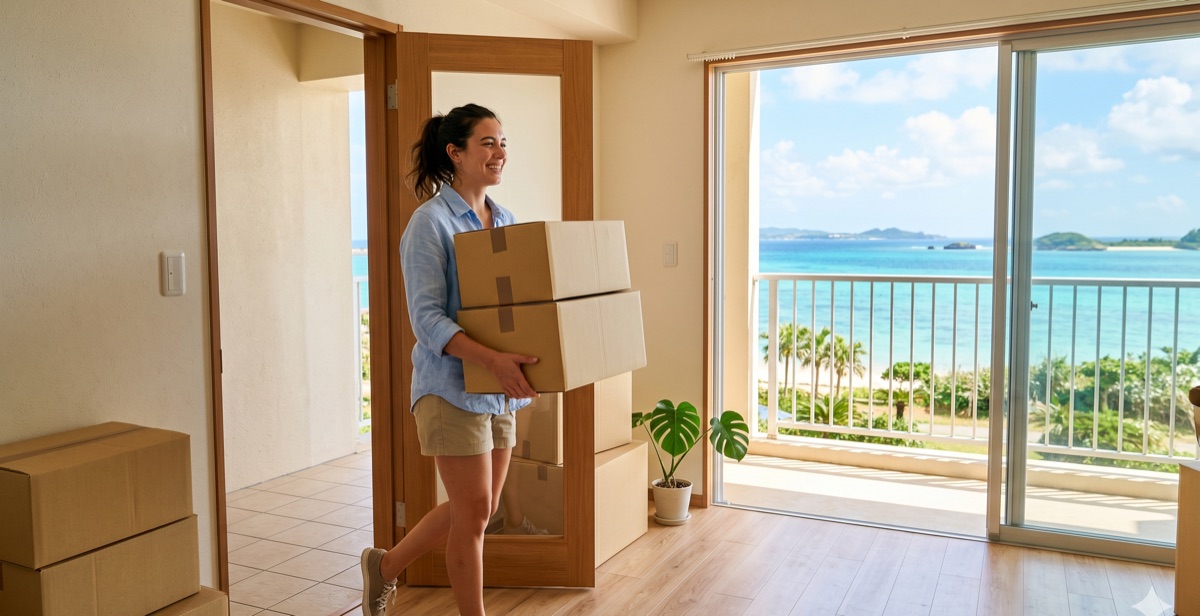
Why Okinawa specifically?
Japan is a big country. Okinawa is not the obvious choice for most people relocating from abroad — it has limited rail, a subtropical climate that grows mold if you blink, and a real estate market shaped partly by American military demand. So why do so many expats choose it over Tokyo, Osaka, or even Kyoto?
The honest answer is lifestyle. Okinawa moves slower. Beaches are ten minutes from most houses, not two hours. The food is exceptional and cheap. The expat community — built around 50,000-plus US military and civilian residents — means English is genuinely functional in daily life. And the cost of living, while not Southeast-Asia cheap, is meaningfully lower than mainland Japan's major cities.
But it takes real preparation to land here well. The bureaucratic sequence matters enormously: do things out of order and you'll wait weeks for a bank account while living on cash. This guide walks you through that sequence, from the visa you'll need before you leave to the driver's license exam you'll face after you arrive.
The master checklist
Moving to Okinawa has a specific order of operations. These aren't optional steps — each one unlocks the next. Here's the full picture before we go deep on each.
Step 1: Choose your visa
Japan has no general "residency by investment" or retirement visa. Your path to long-term status depends on your situation. Here are the most common routes people use to move to Okinawa:
Spouse of Japanese National
Work anywhereMarried to a Japanese citizen or permanent resident? This gives you one of the freest statuses in Japan — no job-type restriction, work full-time, part-time, or freelance. Renewable as long as the marriage is genuine.
What you need: Marriage certificate, proof of genuine relationship (photos, chat history, joint finances), and stable household income. Processing: 1–3 months.
Engineer / Specialist in Humanities
Tied to employerJapan's standard skilled work visa covers engineers, IT workers, teachers, designers, researchers, and most knowledge-work roles. Requires a Bachelor's degree or 10 years of relevant experience.
What you need: A Japanese employer who sponsors your Certificate of Eligibility (COE). COE processing takes 1–3 months, then 3–10 days for the visa stamp.
Working Holiday
Easy to getAvailable to citizens of ~30 countries including Australia, New Zealand, Canada, UK, and Ireland. Ages 18–30. Allows living and working in Japan for up to 12 months, non-renewable. A popular first step before securing a work visa.
What you need: Proof of sufficient funds (roughly ¥300,000), return airfare, no dependents. Apply at your nearest Japanese consulate.
Digital Nomad Visa
Cannot be renewedUp to 6 months for remote workers earning ¥10 million+ annually from overseas sources. You can bring family. Health insurance from your home country must be maintained.
What you need: Proof of remote employment or contracts, income documentation, private health insurance. Not renewable — you must leave Japan and re-apply after a cooling-off period.
Highly Skilled Professional (HSP)
Fast PR trackA points-based system rewarding academic background, salary, age, and Japanese ability. Scoring 70+ points qualifies you; 80+ puts you on a fast-track to permanent residency in just 1 year instead of the standard 10.
What you need: Calculate your score at the MOFA point calculator. Salary threshold starts around ¥3–5M/year depending on age and education.
Student Visa
28 hrs/week work allowedLanguage school is the most accessible route — you don't need Japanese ability to enroll. Schools handle much of the COE paperwork. Part-time work up to 28 hours/week is permitted.
What you need: School acceptance, financial proof (~¥2–3 million in savings or a sponsor). Apply 4–6 months before the semester starts.
Important — June 2027 rule change: Japan has announced that foreign residents with unpaid National Health Insurance premiums or National Pension contributions will, in principle, be denied visa renewal or status changes starting June 2027. Enroll and pay from day one.
Step 2: Find housing before you arrive
This is the chicken-and-egg problem of moving to Japan: you need a Japanese address to register as a resident, and you need to be registered to open a bank account. Solving it starts with finding housing before you land.
Okinawa has a more foreigner-friendly rental market than most of Japan, largely because of the military community's long history here. Agencies that work with SOFA-status residents often accommodate civilian foreigners too, and many have English-speaking staff.
Where to search: The dominant Okinawa-local rental portal is e-uchina.net (うちなーらいふ) — Japanese-language but with filters for "外国人入居可" (foreigners OK), "外人住宅" (gaijin housing / SOFA), pet-OK, no key money, and no guarantor needed. The largest inventory by far. For English-language agencies: Shisa Housing, Keystone Agency, Sky Off-Base, and Total Okinawa all have English websites and experience placing foreign tenants. GTN (Global Trust Networks) acts as a rent guarantor if you don't have a Japanese guarantor — essential for most leases.
Upfront costs: A typical Okinawa lease requires a security deposit of 1–2 months' rent, a guarantor company fee of 30–100% of one month's rent, agency fee of one month, fire insurance, and the first month's rent. Key money (礼金) is uncommon in Okinawa — one of the prefecture's real advantages over mainland Japan. Realistic total at signing: ¥400,000–¥600,000 for a typical solo apartment at ¥80,000/month rent (about 4–5 months equivalent, vs. 5–8 months on the mainland). See the Renting in Okinawa guide for the full breakdown.
Pro tip: If you arrive before finding permanent housing, a weekly mansion (furnished short-term apartment) buys you time. Some landlords will accept a foreign address for the lease signing if you have strong documentation — work with an agency that has done this before.
Where to live
Okinawa's main island (Okinawa-Honto) is about 130km long. Where you live dramatically affects your day-to-day life. Here are the areas most relevant to foreign residents:
The heart of Okinawa's expat scene and #1 on Daito Kentaku's livability ranking for 7 consecutive years. The Sunabe seawall is lined with dive shops, cafés, and English-menu restaurants. American Village is walking distance. Easy access to Kadena Air Base makes it popular with military families and their civilian neighbors.
Tradeoff: Rents are the highest on the island. Expect ¥90,000–¥130,000/month for a 2LDK — and ¥150,000–¥210,000 if you want walking distance to American Village.
Central location — equidistant from Naha and Chatan. More local feel than Chatan with still-solid English access. Good hospital options. Many civilian families choose Ginowan for the balance of convenience and slightly lower rents.
Tradeoff: Less beach access than Chatan. Traffic on Route 58 can be brutal. Aircraft noise from Futenma in some areas.
North of Chatan, Yomitan is known for pottery (yachimun), beaches, and a slower pace. Kadena Town surrounds the air base. More residential, less commercial — you'll need Japanese for most daily errands here. Families who want more space gravitate to this area.
Tradeoff: Fewer English-language services. Longer drive to Naha.
Okinawa's capital. The only city with a rail line (Yui Rail monorail, now reaching Tedako-Uranishi in Urasoe). Closest thing to mainland city living — dense, walkable in the center, strong food scene, international airport nearby. Good choice if you're working in government or large companies.
Tradeoff: Farther from the expat community and most beaches. Parking is scarce and expensive.
Adjacent to Kadena Air Base, Koza has a gritty, multicultural character unlike anywhere else in Japan — a legacy of the postwar American administration. Live music, good cheap food, more affordable rents. The choice for those who want immersion over comfort.
Tradeoff: Less polished than Chatan. Fewer English amenities.
The west coast north of Chatan is stunning — resort hotels, diving, whale sharks at Churaumi. Remote workers and retirees who prioritize scenery and quiet choose this area. Everything is a drive away, including a decent supermarket.
Tradeoff: Genuinely remote. Resort villas near Cape Manza can list at ¥200,000–¥300,000; standard apartments in the village interior are much cheaper.
For a deeper area-by-area comparison with strengths, tradeoffs, and full pro/con lists, see the Best Neighborhoods for Expats guide.
Step 3: Shipping your belongings
If you're moving from abroad, the big decision is what to ship and how. Japan's customs rules are clear but have important deadlines.
The duty-free window
If you've lived abroad for at least one year, your used personal belongings can be imported free of duty and tax — clothes, furniture, books, kitchenware, small appliances. The catch: everything must arrive within 6 months of your entry date. Miss that window and duty applies.
New items (still in boxes, clearly unused) and commercial goods do not qualify for the exemption. Japan Customs will examine your inventory list, so be honest and detailed.
Sea vs. air freight
| Method | Transit Time | Cost (20-box shipment) | Best For |
|---|---|---|---|
| Sea freight | 4–8 weeks | ¥150,000–¥400,000 | Furniture, full household goods |
| Air freight | 1–2 weeks | ¥300,000–¥800,000+ | Electronics, clothing, urgent items |
| Checked luggage only | Immediate | Airline fees only | Starting light; ship later |
What to leave behind: Japan has excellent, affordable secondhand shops (Hard Off, Book Off, recycle shops in every city). Large furniture is often cheaper to replace than to ship. Yamato's Kuroneko International service is reputable and Okinawa-experienced.
Prohibited items: Meat and meat products, fresh vegetables and fruit, soil, firearms, and certain pharmaceuticals are either banned or heavily restricted. Medications you depend on should be declared; some common foreign drugs are controlled substances in Japan. Check with the Japanese Ministry of Health before packing your medicine cabinet.
Step 4: The first 14 days (the registration sprint)
Your first two weeks in Okinawa are the most bureaucratically dense. Every other step — banking, health insurance, driving — depends on completing this sequence first.
Step 5: Opening a bank account
Japan's banking system requires a registered address and a juminhyō before you can open an account. There's no shortcut — complete step 4 first.
Banks tightened their Know Your Customer procedures through 2025–2026 in response to fraud involving foreign residents. Some branches now ask for more documentation than their own websites list. Go in person, bring everything, and be patient.
Which bank?
| Bank | Foreigner-Friendly? | Notes |
|---|---|---|
| Japan Post Bank (ゆうちょ) | ✓ Most accessible | Accepts new residents, English ATMs everywhere, basic account. Start here if turned down elsewhere. |
| Bank of the Ryukyus (琉球銀行) | ✓ Local | Okinawa's largest regional bank. Rare English service, but widely accepted by landlords and utilities. Best ATM coverage. |
| Bank of Okinawa (沖縄銀行) | ✓ Local | Second-largest. Strong presence in central Okinawa. Similar process to Ryukyu Bank. |
| Okinawa Kaiho Bank (沖縄海邦銀行) | ✓ Local | Third local bank. Smaller branch network but competitive on mortgage products. |
| Sony Bank / SBI Shinsei | ✓ Online-first | Online banks with English interfaces. Good for international transfers and FX rates. Apply online after getting your address registered. |
| MUFG / SMBC / Mizuho | Varies | Major national banks. Generally require 6+ months of residency. Some branches more foreigner-friendly than others. |
What to bring: Residence Card, passport, juminhyō (issued within the last 6 months), My Number Card (or notification letter), and a Japanese phone number. Some banks also want a seal (hanko) — a cheap personal stamp from any ¥100 shop works for basic accounts.
Wise or Revolut as a bridge: While waiting to open a Japanese account, Wise and Revolut work in Japan and let you receive transfers and pay by card. Not a substitute for a local account — you'll need one for rent and utilities — but useful for the first few weeks.
Step 6: National Health Insurance
Japan's NHI covers 70% of most medical costs for enrolled members. The remaining 30% is your copay at the counter. Emergency care, surgery, outpatient visits — all covered at this split.
Premium calculation: NHI premiums are set by your municipality and based on your prior year's income. If you've just arrived from abroad with high foreign income, your first-year premium can be surprisingly large — calculated on what you earned before you moved. If your income will drop significantly in Japan, visit the city office and ask about income-based reduction (軽減), which can lower premiums substantially for low earners.
The 2027 warning: Japan formally announced in January 2026 that unpaid NHI or pension contributions will block visa renewal starting June 2027. This is now policy, not a rumor. Pay on time every month.
If you're employed: Most full-time employers enroll you in Shakai Hoken (社会保険) instead of NHI — the employee health insurance system. It's better: premiums are lower because the employer pays half, and coverage is slightly broader. Ask your HR department which system applies to you.
Step 7: Convert your driver's license
In Okinawa, a car is not a luxury. The monorail only covers central Naha, and buses are infrequent outside the main corridors. Plan on driving — which means getting a Japanese license.
The process is called gaimen kirikae (外免切替) and it's handled at the Okinawa Prefectural Driver's License Center in Naha. As of October 2025, the rules tightened significantly: pass rates on the practical exam dropped to just 13% after the update. Start early.
Which countries are exempt from testing?
Licenses from the following countries skip both the written and practical exams: Australia, New Zealand, Canada, most EU countries, UK, Switzerland, South Korea, and Taiwan. You still need a document check and eye test at the license center, but there's no exam.
For US license holders, only 7 states are currently exempt: Colorado, Hawaii, Maryland, Ohio, Oregon, Virginia, and Washington. Holders of all other US state licenses must pass both the written exam (50 questions, 90% pass mark) and the practical driving test.
What you need
- Original foreign driver's license (valid, not expired)
- Expired previous licenses if applicable (for the 3-month overseas residency proof)
- Official Japanese translation from JAF (Japan Automobile Federation) or your embassy
- Current passport with entry/exit stamps showing 3+ months in the issuing country
- Residence Card and juminhyō
- Passport photo (3cm × 2.4cm, taken within 6 months)
The 3-month residency requirement: You must prove you lived in the country that issued your license for at least 3 months after obtaining it — not just any time. Bring all your passports with stamps. If you've moved countries frequently, JAF can help you document your history.
JAF translation fee: Approximately ¥3,000 per license. Allow 2–4 weeks for delivery if ordering by mail. JAF has an Okinawa office in Naha that handles in-person submissions and international driving permits if you need one while waiting.
Okinawa gasoline tax exemption: One nice surprise once you start driving here — gasoline in Okinawa runs roughly ¥5.5/L cheaper than mainland Japan. The exemption dates to the 1972 reversion-to-Japan special measures and was renewed through May 14, 2027. It is unique to Okinawa among Japanese prefectures and applies to all drivers, not just locals. Diesel is not covered. See the Cost of Living guide for details.
Step 8: Get a phone plan
Japan's major carriers (SoftBank, au, Docomo) are expensive and often require a Japanese bank account upfront. MVNOs — budget carriers that piggyback on the big networks — are far more accessible for new arrivals.
Recommended for new arrivals: IIJmio, Rakuten Mobile, and UQ Mobile offer plans starting around ¥1,000–¥2,000/month, activation with a residence card and passport, and reasonable English support. Rakuten Mobile's unlimited plan at ¥3,278/month is particularly popular with the expat community.
You'll need a Japanese phone number almost immediately — banks, utilities, and city offices all ask for one. A cheap SIM on arrival is worth the hassle.
Step 9: Set up utilities
Most landlords can walk you through utilities setup or handle it for you initially. The main providers in Okinawa:
- Electricity: Okinawa Electric Power Company (沖縄電力). Call or set up online — they have some English support.
- Water: Often included in rent. If not, it's billed by the municipality.
- Gas: Many Okinawa apartments use propane (LPG) rather than piped gas — the cylinder company is listed in your lease.
- Internet: NTT Flet's, Docomo Hikari, SoftBank Hikari, and the Okinawa-specific au Hikari Chura (auひかりちゅら) all offer fiber. au Hikari Chura is the local KDDI joint-venture product — often the most competitively priced in Okinawa. Allow 2–4 weeks for installation. In the meantime, a mobile Wi-Fi router from your MVNO can bridge the gap.
Humidity warning: Okinawa summers are genuinely brutal — 90%+ humidity for months. A dehumidifier is not optional. Budget ¥15,000–¥30,000 for a good one and run it constantly June through September. Mold will destroy clothing, leather goods, and electronics if you don't.
What it costs to get established
Beyond ongoing monthly costs (covered in our Cost of Living guide), moving to Okinawa has significant one-time upfront costs. Here's a realistic picture:
| Item | Typical Range | Notes |
|---|---|---|
| Housing move-in costs | ¥400,000–¥600,000 | Deposit, guarantor fee, agency fee, fire insurance, first month (key money rare in Okinawa) |
| Sea freight shipping | ¥150,000–¥400,000 | US/Australia to Okinawa; varies by volume |
| Initial furniture/appliances | ¥100,000–¥300,000 | Less if buying secondhand (highly recommended) |
| Car purchase (used) | ¥300,000–¥800,000 | Kei car is the practical Okinawa choice |
| License conversion + JAF translation | ¥8,000–¥25,000 | Higher if you need driving lessons for practical exam |
| Phone setup | ¥5,000–¥30,000 | SIM + unlocked phone or new device |
| First month NHI premium | ¥5,000–¥50,000 | Depends on prior year income; reductions available |
| Realistic total (without car) | ¥500,000–¥1,200,000 |
That's roughly $3,300–$8,000 before you factor in a vehicle. Coming with more financial cushion than you think you need is wise — the first months have unpredictable costs.
Japanese — how much do you need?
In the Chatan–Ginowan expat corridor, you can survive on English for daily life: most restaurants have picture menus or English, convenience stores are self-explanatory, and many landlords and agencies have English-speaking staff. But "survive" is not "thrive."
The city office, the tax office, the driver's license center, the insurance counter — all are primarily Japanese. Google Translate's camera mode and DeepL have transformed the experience dramatically, but having even basic Japanese (JLPT N5 or N4 level) will save you hours of frustration at the most critical bureaucratic moments.
Okinawa has language exchange communities (HelloTalk, local language cafés) and private tutors are affordable. Spending your first 3 months on intensive beginner Japanese is one of the highest-ROI investments you can make for your first year here.
Finding your people
Okinawa has an unusually established expat infrastructure for an island of its size, almost entirely because of the American military presence. Even if you have no military connection, you benefit from it:
- Facebook groups: "Okinawa Expats," "Okinawa Hai" (the longest-running expat community), and neighborhood-specific groups are active and helpful.
- Meetup.com: Regular hiking groups, language exchanges, and professional networking events in Naha and Chatan.
- Okinawa International Center (JICA): Japanese language classes, cultural programs, and orientation resources for new residents.
- Dive shops: The Sunabe seawall dive community is one of the fastest ways to meet both expats and locals with shared interests.
- Church communities: Several English-language and international churches serve the expat community across central Okinawa.
What nobody warns you about
Typhoon season is real. June through November, Okinawa sits in one of the most active typhoon corridors in the Pacific. A serious storm will shut down the island for 1–2 days — stores close, flights cancel, and you stay home. Stock emergency supplies: 3 days of water, food, batteries, and a charged power bank.
Isolation creeps up on you. Okinawa is geographically isolated — a 2-hour flight from Tokyo, more than that from anywhere else. If you're coming from a place with a large personal network, the first 6 months can be lonelier than you expect. Plan for this intentionally: join things, say yes to invitations, and give community-building the same priority you give the bureaucracy.
Banking will frustrate you. Japan's cash culture is not a myth. Many landlords, local restaurants, clinics, and even some government offices only accept cash. Set up a Japan Post Bank account early and keep ¥30,000–¥50,000 accessible at all times.
The paperwork never fully ends. Visa renewals, tax filing, pension statements, health insurance adjustments — Japan requires engagement with bureaucracy on a regular basis. Build a system for tracking deadlines and keeping copies of all documents. A simple folder (physical and digital) will save you repeatedly.
Kei cars are the right answer. Okinawa's roads, parking lots, and gas prices all favor the kei car (軽自動車) — Japan's tiny-engine city vehicles. They're cheap to buy used (¥300,000–¥600,000 for a reliable one), cheap to insure, easy to park, and very fuel efficient. Resist the urge to import your full-size SUV.
Frequently asked questions
Sources & further reading
- うちなーらいふ (e-uchina.net) — Okinawa's dominant rental portal
- 沖縄県公式 — 揮発油税等(ガソリン税)の軽減措置
- 沖縄県警察 — 運転免許センター (driver's license center, Naha)
- 沖縄労働局 — 労働関連手続き (Okinawa Labor Bureau)
- 琉球銀行 — 個人向けサービス (Bank of the Ryukyus)
- 沖縄銀行 (Bank of Okinawa)
- 沖縄電力 (Okinawa Electric Power)
- au Hikari Chura (auひかりちゅら) — Okinawa fiber
- 沖縄県公式移住応援サイト — おきなわ島ぐらし
- 外務省 — 長期滞在ビザ (MOFA long-stay visa types)
- Japan Customs — Household Effects Import Procedures
- JAF — Foreign Driver's License Translation Service
- Go Go Nihon — Tokutei Zairyu Card (Combined Residence + My Number) 2026